Continual learning research · measured result · November 2026
A third of forgetting is the arbitrary choice in the example
With the content of every demonstration held perfectly fixed, the convention alone moves forgetting by a third, and a skill learned from all equally good answers at once has no convention to lose.
Measured result · November 2026
The arbitrary choice in a demonstration is a third of what gets forgotten
Most tasks have several equally right answers, and a demonstration has to show one of them. That pick, the convention, is not content: any of the answers would do. In grid worlds where an exact solver knows every best move, I could hold the content of every demonstration perfectly fixed and vary only the convention. Teaching a second task with demonstrations that break ties the opposite way from the first task’s costs a third of the first skill, with identical content. A skill learned from all the right answers at once has no convention to lose, and keeps that third.
1,088 training runs over two days: 624 on one rented GPU for the main grid (6 task pairs, 26 ways of teaching, 4 seeds), 136 follow-ups, 328 on a CPU for a synthetic model. Predictions were written down before the sweep. Small networks and small worlds; not yet tested on language models.
Three numbers
| Comparison | Retention | Cells with the same sign |
|---|---|---|
| Second task taught with the opposite tie-break instead of the same one (identical content) | −0.10 | 24 of 24 |
| First skill learned from all optimal actions at once instead of one canonical path, opposite tie-break later | +0.10 | 24 of 24 |
| The same all-answers skill when the two tasks happen to share a tie-break | ±0.00 | 8 of 24 |
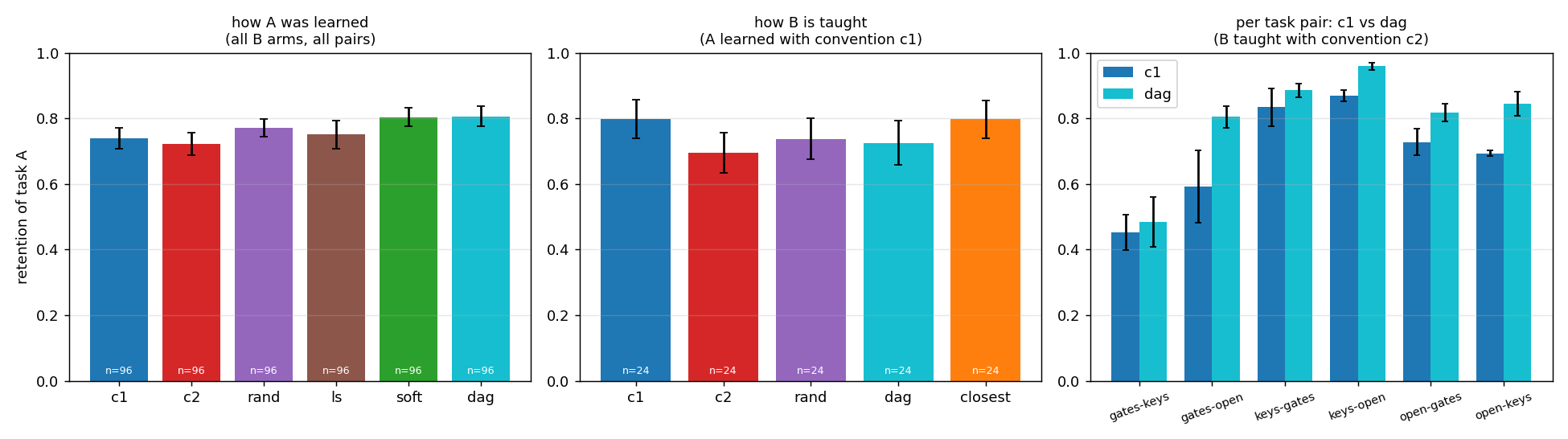
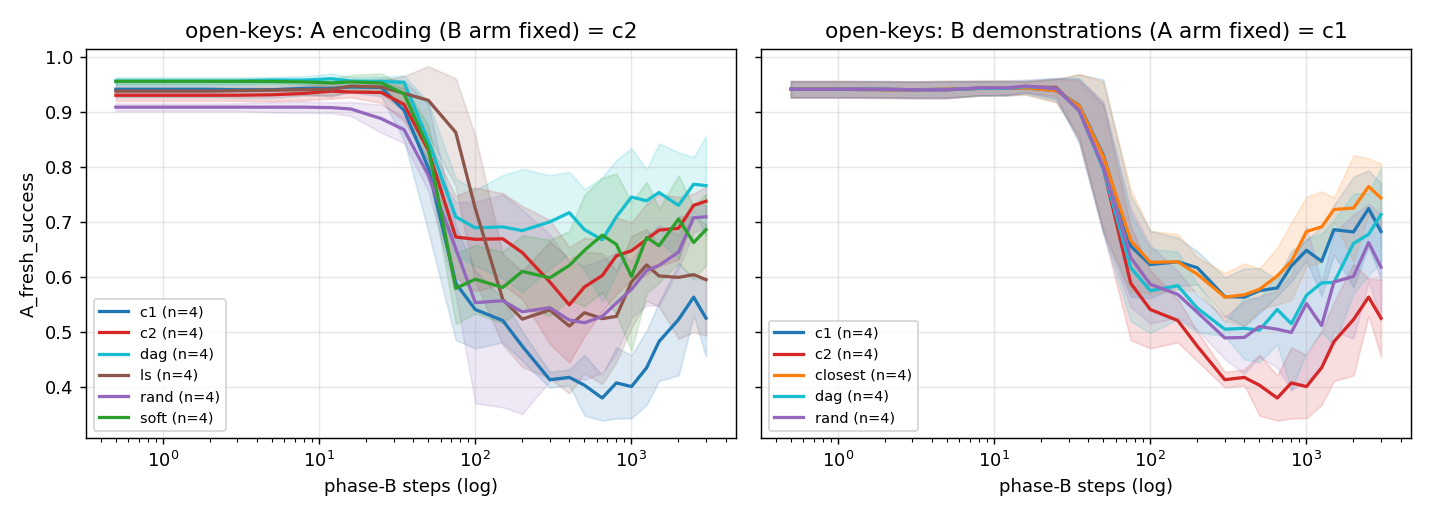
Long Game levels (keys, gates, open rooms) have a solver that finds every reachable state and its best moves. Every demonstration is provably optimal; the training arms differ only in which equally good move they show, or whether they show all of them. A small network learns one task for 6000 steps, then another for 3000 with no data from the first, and the first task is measured exactly 28 times along the way.
Re-choosing, among optimal paths, the one the current policy already prefers recovers exactly the convention effect (+0.10, 24 of 24). A controlled reason why on-policy data forgets less (RL’s Razor, ICLR 2026; Self-Distillation Fine-Tuning, 2026): it cannot clash with the learner’s conventions.
At the same KL divergence from the original policy, a skill without conventions loses about half as much success as a canonical one. For a canonical skill, over half of its measured shift is harmless drift among equally good moves.
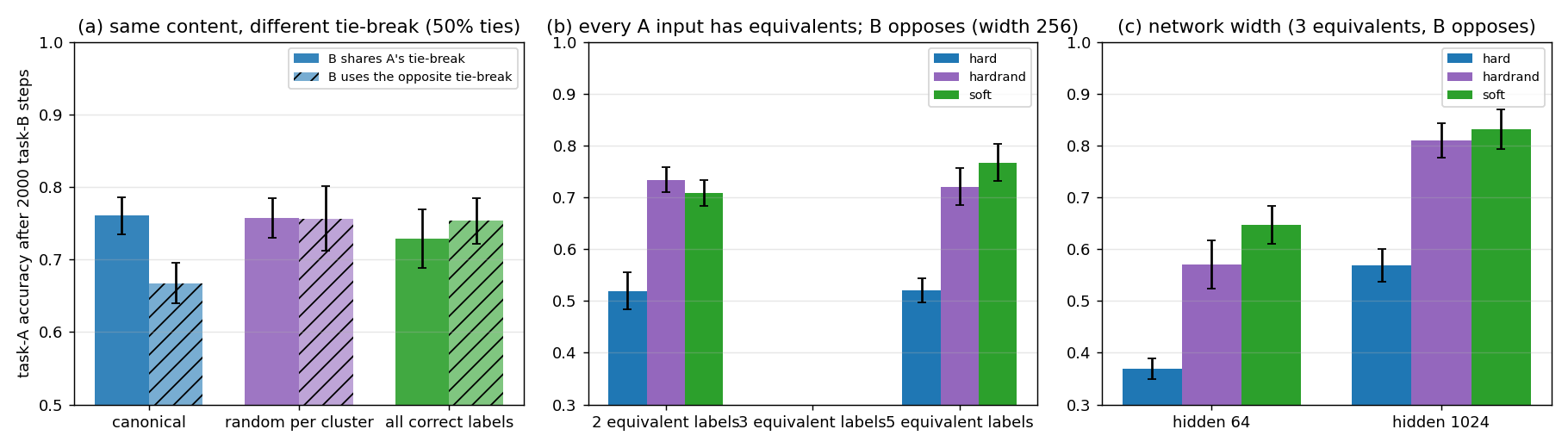
Holds with the optimizer state kept across tasks (+0.13), a 3× higher learning rate (+0.12) and a 2× wider network (+0.12). Memorised levels forget as fast as new ones. Heavy label smoothing (0.3–0.5) also removes most of the cost in the grid worlds, but not in the synthetic model below. Refining the canonical skill with on-policy reinforcement learning leaves its convention in place and gains nothing unless pushed with a strong entropy bonus, which costs accuracy.
Practical reading: when several answers are correct, train the skill you want to keep on all of them, or on the learner’s own preferred ones; when fine-tuning later, prefer demonstrations that match the model’s existing conventions.
The same signature in a synthetic model
A small classifier where each input cluster has several correct labels, and a second task that shares the output layer. The gap between the canonical and the all-answers encoding is zero when no input has equivalents and 15 points when every input does; a clashing convention costs 9 points; label smoothing hurts here.
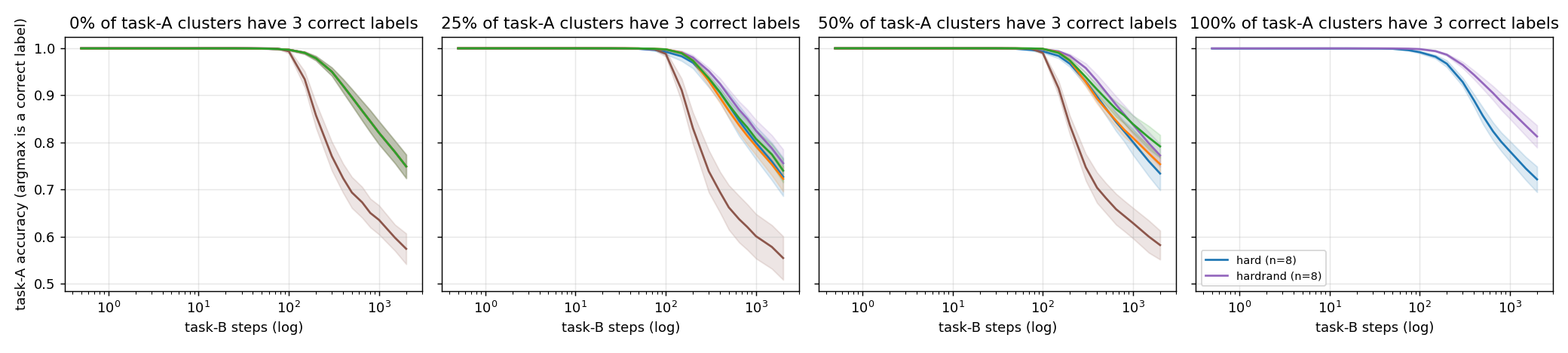
Code, pre-registered protocol and the full report with every number: research-lab/experiments/exact-oracle-forgetting (report.md). One RTX 4090 for 4.8 hours, about $4. A rough draft of the paper, with the closest prior work, is at /paper/conventions-forgetting/.
More research